
KSA Industrial Automation Company provides cement plant automation in Saudi Arabia: PLC, HMI and SCADA programming for raw mill, kiln, cement mill and dispatch, with commissioning planned into your annual shutdown. S7-300 migrations typically take 3–8 weeks, with cut-over in planned shutdowns. Our focus is one outcome: kiln and mill running again on schedule.
What you receive: a written proposal covering scope, a phased cut-over plan and price, delivered within one working day of your I/O list and drawings. Request a quotation
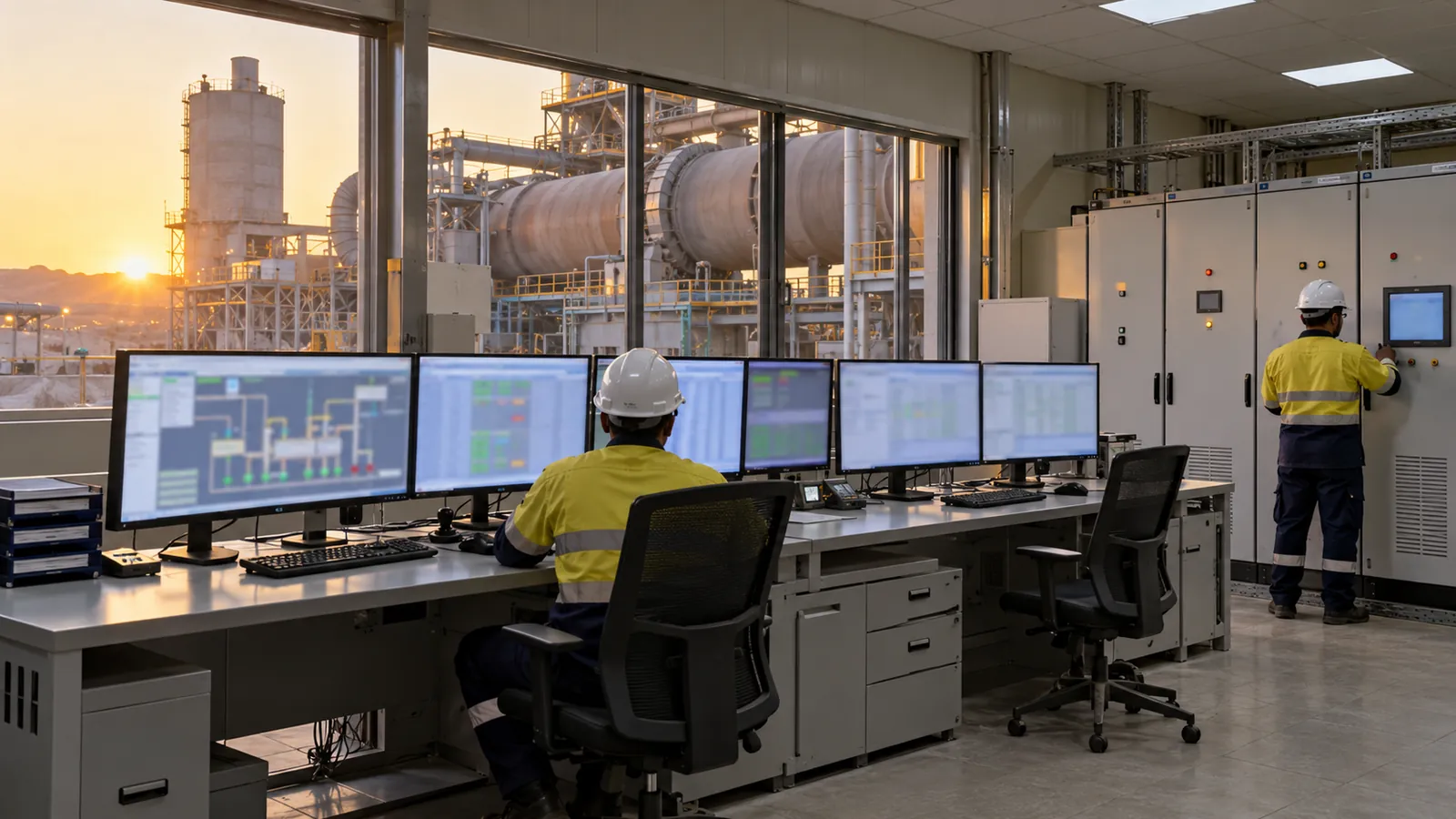
Cement plant automation: areas we cover
| Plant area | Typical control scope | Platforms | Typical duration |
|---|---|---|---|
| Raw mill and cement mill | Group start and stop, feeder control, interlocks | S7-1500, ControlLogix, Modicon M580 | 2–6 weeks per system |
| Kiln, cooler and fans | Sequence control, trip logic, trending | S7-1500, ControlLogix | 2–6 weeks per system |
| Filters, silos and packing | Pulse cleaning, level, bagging and loading | S7-1200/1500, Modicon M340 | 1–4 weeks per area |
| Plant SCADA and historian | Process screens, alarms, shift reports | WinCC, FactoryTalk, AVEVA, Ignition | 4–12 weeks |
| Legacy PLC migration | Code conversion, I/O mapping, cut-over plan | S7-300 to S7-1500 | 3–8 weeks |
Programming follows IEC 61131-3. Our PLC retrofit and upgrade page describes the phased method.
How does automation run a cement mill circuit?
A mill circuit is a chain of motors that must start in the right order and stop in reverse. The PLC runs the group sequence: lube pumps first, then fans and separator, then mill, then feeders, each step waiting for proof of running. Any trip stops everything upstream, so material does not pile on a stopped belt. The operator sees the whole chain on one SCADA screen, with the first-out trip highlighted, which shortens every restart.
Can an obsolete S7-300 system be replaced during a shutdown?
Yes, if the work is staged. Cement plants rarely stop for long, so we prepare everything before the shutdown window opens. We convert and test the code on a bench, map every I/O address, pre-wire the new racks and write a cut-over plan with a rollback step. Your plant then loses hours, not days. Details of the route are on our S7-300 to S7-1500 migration page.
What is different about control cabinets in dusty, hot plants?
Dust, heat and long cable runs shape the design. We place remote I/O stations near the equipment to shorten wiring, keep air-conditioned or sealed cabinets for the controllers, and specify screens that stay readable in glare. Networks use ring topologies, so a single cable break does not blind the kiln. Every analogue loop gets scaling and a bad-signal alarm, because a dirty sensor is more common than a failed PLC.
How does a cement automation project run?
- You send I/O lists, drawings and any existing PLC backups.
- We survey the installed system, then issue the proposal and cut-over plan.
- We write the functional design and agree it with your process team.
- We programme and test on a simulated plant.
- Your engineers witness the functional FAT.
- We install, check loops and commission in your shutdown. Support is remote the same day and on site within one working day in the Eastern Province.
- You receive backups, as-built code and operator training.
Proof and coverage
KSA Industrial Automation Company was established in 1995, and we have worked on projects for Saudi Aramco, SABIC and the Royal Commission for Jubail and Yanbu. We hold ISO 9001, ISO 14001 and ISO 45001 certification. Cement plants sit well away from the main cities, so we plan travel, spares and site access with your team. We are available for projects across Saudi Arabia, including Eastern Province, Riyadh, Jeddah and Yanbu.
Cement automation questions
Who provides cement plant automation in Saudi Arabia?
KSA Industrial Automation Company provides PLC, HMI, SCADA and commissioning services for cement works from its base in Dammam. It has operated since 1995 and is approved by Saudi Aramco, SABIC and the Royal Commission.
What affects the cost of a cement PLC and SCADA project?
Cost depends on I/O count, the number of plant areas, the platform you choose, the amount of legacy code to convert, the FAT scope and the time needed in your shutdown. A drawing set and PLC backups let us price accurately.
How long does a cement PLC upgrade take?
It depends on I/O count and the shutdown window. A PLC programme typically takes 2–6 weeks per system, and an S7-300 migration 3–8 weeks. Most preparation happens on a bench before the plant stops.
Can you keep our existing SCADA while replacing PLCs?
Yes. We keep the tag names, screens and alarm lists you use today wherever possible, so operators see the same plant on the first day after cut-over and your existing reports continue unchanged.
Do you integrate motor control centres and drives?
Yes. We connect MCC intelligent relays and drives over Profibus, Profinet or Modbus, so starter status, motor current and fault codes reach SCADA without extra hard wiring back to the PLC.
What should we send for a quotation?
Send your I/O list, P&IDs or functional description, a backup of the current PLC program if one exists, and your planned shutdown dates. That lets us fix the scope and the cut-over plan.
Need cement plant automation in Saudi Arabia? Send us your plant I/O list and current PLC backups, and get a quotation within one working day. Email: inquiry@ksaindustrialautomation.com | Request a quotation