
KSA Industrial Automation Company provides district cooling automation in Saudi Arabia: PLC control, SCADA and telemetry for chiller plants, thermal storage, pump sets and energy transfer stations. Chiller plant SCADA typically takes 4–12 weeks. Our controls stage chillers and pumps to protect chilled-water supply, because a lost cooling load costs more than any energy saving.
What you receive: a written proposal with control sequences, platforms, duration and price, sent within one working day of your P&IDs or sequence of operation. Request a quotation
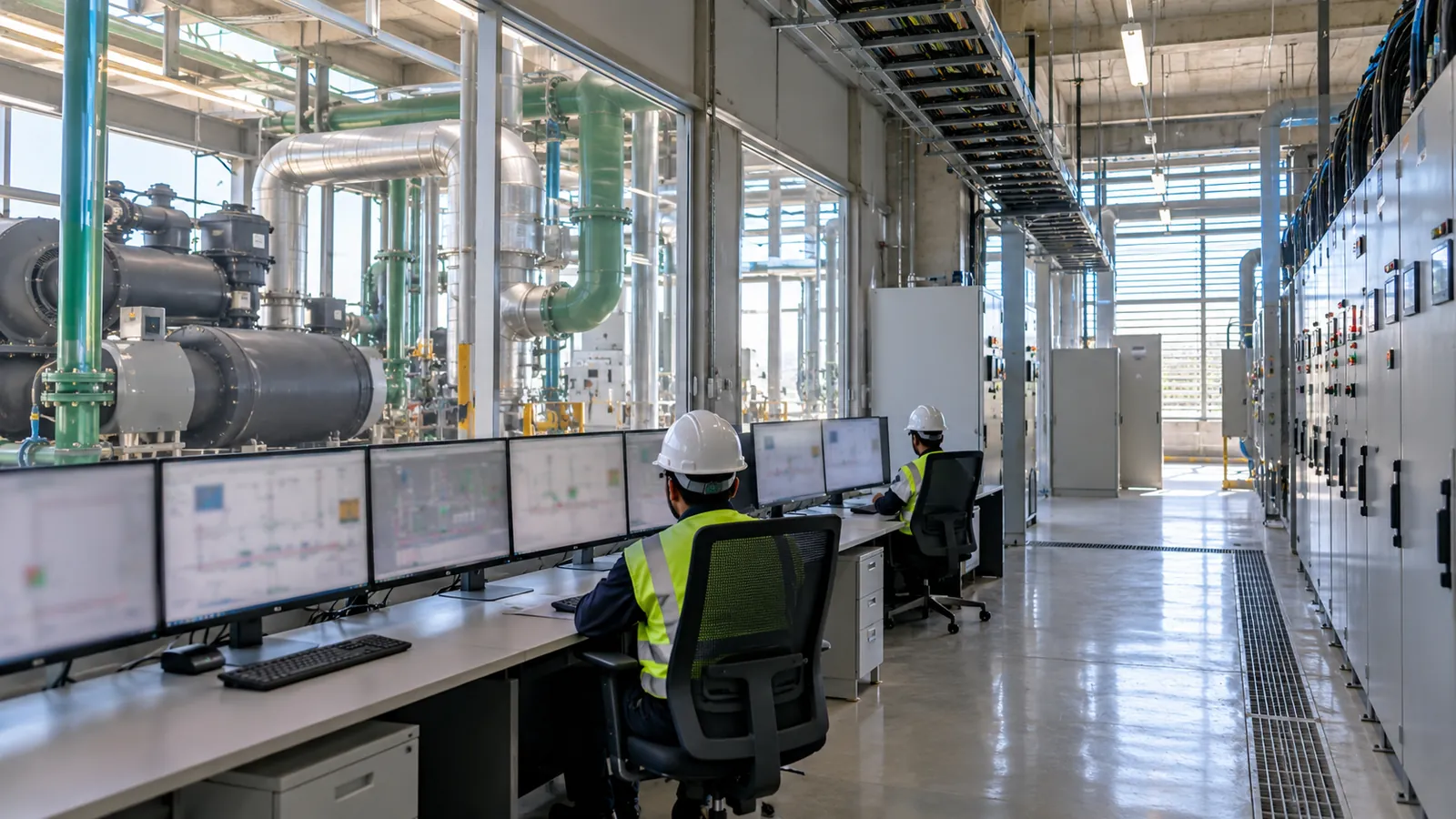
District cooling automation: what we deliver
| Scope | Platforms and range | Standard | Typical duration |
|---|---|---|---|
| Chiller plant sequencing and pump control | S7-1500, ControlLogix, Modicon M580 | IEC 61131-3 | 2–6 weeks per system |
| Plant SCADA, historian and KPIs | WinCC, FactoryTalk, AVEVA, Ignition | ISA-18.2, ISA-101 | 4–12 weeks |
| Energy transfer station telemetry and metering | Modbus, M-Bus gateways, DNP3, OPC UA over fibre, 4G or radio | IEC 62443 basics | 3–8 weeks |
| Thermal storage and valve control | S7-1500, ControlLogix, ABB AC500 | IEC 61131-3 | 2–6 weeks per system |
| FAT, SAT and loop checks | Loop folders and ITPs | Project procedure | Per project schedule |
Remote sites share the techniques on our remote monitoring and IIoT page.
How does chiller plant automation keep supply temperature stable?
The PLC matches the number of chillers to the cooling demand measured from flow and return temperature. When load rises it starts the next chiller and its pumps in a set order, waits for proof of flow, then loads it. When load falls it stops the least efficient unit first. Staging has delays and minimum run times so machines do not cycle. Supply temperature stays inside its band and the standby chiller is always ready.
What does an energy transfer station need from a control system?
An energy transfer station, or ETS, is where the network hands cooling to a customer building. It needs a heat meter, control valves and temperature sensors, plus a link back to the plant. Telemetry reads flow, supply and return temperature and energy consumed, so billing and network balancing use real data. We also watch delta-T, because a low value means the network is pumping more water for the same cooling. Each ETS reports to SCADA as a standard block.
How is a district cooling plant monitored remotely?
The SCADA collects readings from every plant and station, stores them and shows availability, delta-T and kW per tonne of refrigeration. Operators receive prioritised alarms at the control room and by e-mail for out-of-hours cover. Links run over fibre, 4G or radio with a backup path, and cyber-security follows the IEC 62443 basics: segmented networks, role-based access and logged changes.
How does a district cooling project run?
- You send P&IDs, an I/O list or a sequence of operation.
- We review the plant and network, then issue the proposal.
- We write the functional design and control sequences.
- We programme, simulate the plant and run FAT.
- We commission section by section at low-demand hours, with the new PLC in parallel with the old one and a written rollback for each step, during commissioning.
- You receive backups, as-built code and operator training.
- Support is remote the same day, and on site within one working day in the Eastern Province.
Where we work
District cooling and industrial utilities serve new developments, industrial cities and airports. Our base is Al Shati District, Dammam, and we have worked on projects for Saudi Aramco, SABIC and the Royal Commission for Jubail and Yanbu. For utility clients, we have worked on projects for Marafiq in Jubail. We are available for projects across Saudi Arabia. We hold ISO 9001, ISO 14001 and ISO 45001 certification. Industrial utilities such as steam, compressed air and utility water use the same control and monitoring methods.
District cooling questions
Who provides district cooling automation in Saudi Arabia?
KSA Industrial Automation Company provides district cooling automation from Dammam, covering plant PLCs, chiller sequencing, SCADA and ETS telemetry. It has operated since 1995 and is approved by Saudi Aramco, SABIC and the Royal Commission.
What affects the cost of chiller plant SCADA?
The main factors are the number of chillers, pumps and valves, I/O count, the number of ETS locations, the platform, the communication path and the reporting needed. A sequence of operation and an I/O list let us price from real quantities.
How long does a chiller plant control project take?
Time depends on plant size, I/O count and how much operating time you can free. PLC programming typically takes 2–6 weeks per system, SCADA 4–12 weeks and telemetry 3–8 weeks.
Can you add SCADA to a plant with existing chiller controllers?
Yes. We read each chiller's own controller over Modbus or the gateway the supplier provides, add plant-level sequencing above them, and leave the chiller's own safety functions and manufacturer settings untouched.
Can you report kW per tonne of refrigeration?
Yes. We combine power meter readings with flow and temperature data to calculate kW/TR per chiller and per plant, trend it by hour and flag a drop in efficiency to your operators.
What should we send for a quotation?
Send your P&IDs, I/O list or sequence of operation, the make of each chiller and controller, and the number of ETS locations. A plant layout also helps us plan the communications.
Need district cooling automation in Saudi Arabia? Send us your sequence of operation and P&IDs, and get a quotation within one working day. Email: inquiry@ksaindustrialautomation.com | Request a quotation