
KSA Industrial Automation Company provides RTU integration and telemetry for remote process and utility sites across Saudi Arabia, linking pump stations, wells, tanks and pipeline stations to your control room over 4G, fibre or radio. We supply the site controller, the communications and the SCADA head-end as one tested system. Most telemetry projects take 3–8 weeks.
What you receive: a written proposal with the site list, hardware, communications design, schedule and price within one working day of receiving your site list and I/O count. Request a quotation
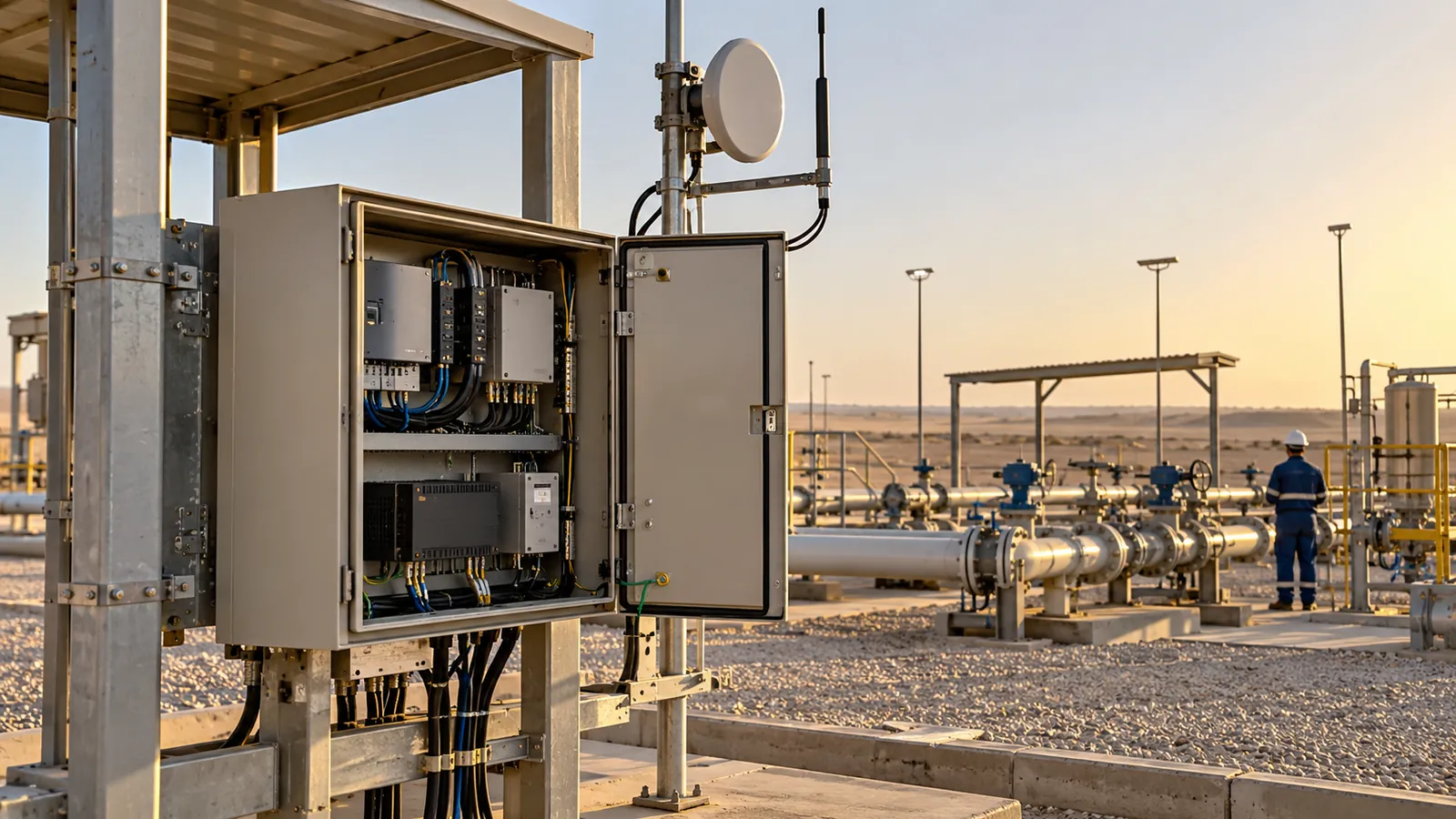
What is an RTU used for?
An RTU, or remote terminal unit, reads field signals at a remote site and sends them to a central SCADA system, then passes commands back to the equipment. Typical signals are tank and reservoir levels, pump and valve status, flow, pressure and analyser readings. A well-built RTU keeps working when the link drops: it holds the last data, logs events and sends them when the connection returns.
RTUs suit sites that are far apart, lightly staffed and powered by modest supplies. A plant with many sites needs one telemetry design that all of them follow, which is what we engineer.
What is the difference between an RTU and a PLC?
An RTU is built for communications over unreliable links, while a PLC is built for fast logic inside a plant. Modern devices overlap, and many telemetry sites now use an RTU-capable PLC. The choice depends on the job:
- RTU. Low power use, many protocols, event buffering and reporting by exception over cellular or radio links. Suited to dispersed sites with simple local control.
- PLC. Faster scan, richer logic and more I/O. Suited to sites that has real control to run, such as duty and standby pumps.
- Both. Larger stations use a PLC for control and an RTU or gateway for the telemetry link.
We recommend the device after the site survey, not before it. The head-end side is covered under SCADA integration.
RTU integration in Saudi Arabia: what we deliver
The scope runs from the field device to the control-room screen. Durations are typical and depend on site count and link design.
| Service | Platforms | Standard | Duration |
|---|---|---|---|
| Site controllers | RTUs or RTU-capable PLCs sized to the I/O of each site | IEC 61131-3 | 3–8 weeks |
| Protocols | Modbus, DNP3, Profinet, Ethernet/IP, OPC UA, MQTT | Per site and SCADA | Within the 3–8 weeks |
| Communications | 4G, fibre or radio links, with path design, antennas and a fall-back route where required | Per project | Within the 3–8 weeks |
| SCADA head-end | WinCC, FactoryTalk, AVEVA (Wonderware) or Ignition; site screens, trends, alarms and reports | ISA-101 and ISA-18.2 where relevant | 4–12 weeks |
| Security | Network zones, remote-access rules, user roles and logging | IEC 62443 basics | Included |
| Testing | Bench FAT of each site design, then a live SAT per site with a signal-by-signal record | Per project ITP | Included |
| Documentation | Site drawings, I/O lists, network diagram, point-to-point records and backups | Per project | Included |
How is a telemetry system built and commissioned?
We build and prove a standard site design on the bench, then repeat it across your sites.
- Enquiry. You send the site list with I/O counts, locations and what each site must report.
- Site data. We survey signal levels, power, enclosure space and coverage, and fix the link type per site.
- Design. We issue the telemetry architecture: devices, protocols, addressing, polling or reporting method and alarm rules.
- Programming. We build the RTU configuration, the communications settings and the SCADA screens and tags.
- FAT. We test a complete site on the bench, including link failure, buffering and recovery, and record the results.
- Installation support and commissioning. On site we check each signal from sensor to screen and confirm the link under real conditions.
- Documentation. You receive drawings, I/O lists, configuration backups and the test records.
- Support. We remain available through the first operating weeks, and remote monitoring can add alarm notification beyond the control room.
Which sites use telemetry in Saudi Arabia?
Telemetry earns its cost where a site is far, unmanned and important. The most common uses we see are:
- water pump stations, reservoirs and wellfields (see pump station automation);
- wastewater lift stations and treatment sites;
- tank farms and storage depots, covered under tank farm monitoring;
- pipeline valve and metering stations; and
- utility and district-cooling remote plant rooms.
KSA Industrial Automation Company has worked in Saudi Arabia since 1995 and is approved by Saudi Aramco, SABIC and the Royal Commission for Jubail and Yanbu. Our work for all three sits within management systems certified to ISO 9001, ISO 14001 and ISO 45001. We take projects in all regions of Saudi Arabia. Long distances and weak coverage in the interior are design inputs for us, so we plan the link before we order the hardware.
RTU integration questions answered
Who provides RTU integration in Saudi Arabia?
KSA Industrial Automation Company provides telemetry and remote-site controls from its base in Al Shati, Dammam, for remote process and utility sites in every region of Saudi Arabia. We are approved by Saudi Aramco, SABIC and the Royal Commission, and we also build the SCADA that receives the data.
What affects the cost of a telemetry system?
Cost follows the number of sites, the I/O at each site, the communications type and coverage, power supply and enclosure requirements, the SCADA size and the security and reporting requirements. A site list with I/O counts lets the proposal price a standard site and each variation.
How long does a telemetry project take?
Telemetry projects typically take 3–8 weeks, and the SCADA head-end 4–12 weeks. The duration depends on the number of sites, hardware lead times, link surveys and access to each location. A standard site design is proven once, so later sites go faster.
What does RTU stand for in SCADA?
RTU stands for remote terminal unit. In a SCADA system it is the field device at a remote site that collects signals, runs simple local logic and communicates with the central SCADA server. It is the telemetry link between the equipment and the control room.
Can you connect our existing remote sites to a new SCADA?
Yes. We survey the existing RTUs and PLCs, confirm their protocols and, where they are compatible, connect them to the new SCADA without replacing the site hardware. Where a controller is obsolete, we propose a staged replacement alongside the telemetry work.
What should I send to get a quotation?
Send the list of sites with their locations, I/O counts and signal types, the SCADA platform if one exists, and the reporting or alarm rules you need. If the sites are not surveyed yet, a map with approximate locations is enough to begin. The proposal then sets out scope, schedule and price.
Need RTU integration in Saudi Arabia? Send your site list and I/O counts and receive a quotation within one working day.
Email: inquiry@ksaindustrialautomation.com | Request a quotation