KSA Industrial Automation Company provides water treatment plant SCADA in Saudi Arabia, covering the PLC layer, operator screens, alarm management, historian and reporting for RO, filtration, effluent and sewage treatment plants. We design the system for plant availability, commission it against your process, and leave you with source code, documentation and trained operators.
What you receive: a written proposal with the system architecture, I/O and tag scope, alarm approach, reporting list and schedule within one working day of receiving your P&IDs, I/O list or functional description. Request a quotation
What does SCADA do in a water treatment plant?
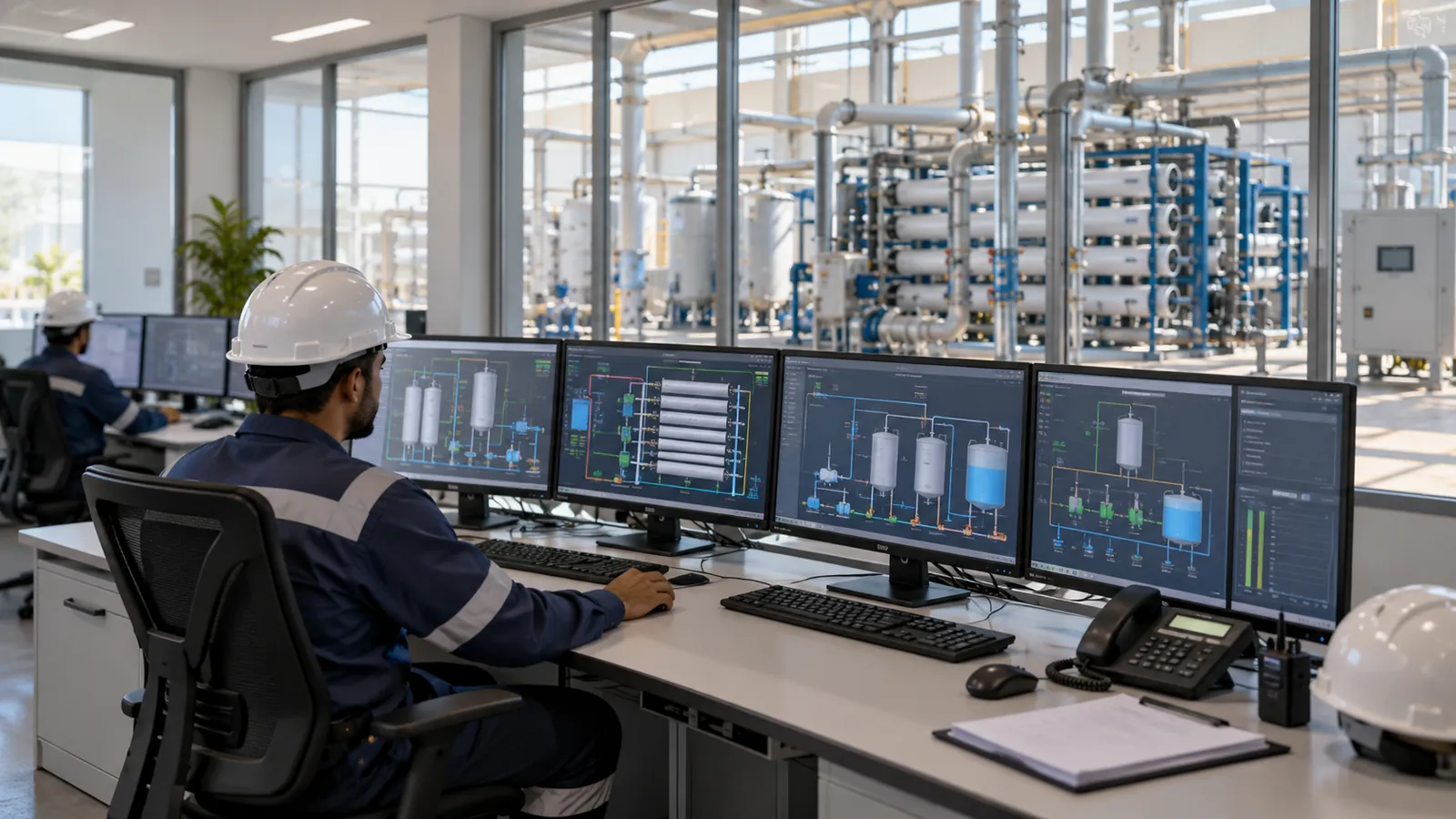
SCADA gives operators one view of the whole plant and records what happened. It collects readings from PLCs, shows the state of each stage, raises alarms, keeps history and issues the reports that your operator, client or regulator asks for. The PLCs still run each process stage; SCADA supervises them.
In a typical plant the SCADA covers:
- intake, transfer pumps and storage level;
- pretreatment, coagulation, clarification and media or membrane filtration;
- RO trains with feed pressure, permeate flow, conductivity and recovery;
- chemical dosing with flow-paced or residual-trim control;
- aeration, sludge handling and effluent discharge in sewage treatment plants; and
- disinfection, product storage and distribution pumping.
Our HMI development standard keeps screens readable at night shift: plain colours, alarms in colour only when abnormal, and trends where the operator needs them.
Water treatment plant SCADA: what we deliver
| Item | Scope / platform | Standard | Typical duration |
|---|---|---|---|
| Plant PLC programming | Siemens S7-1500, Rockwell ControlLogix, Schneider Modicon M580 or ABB AC500 | IEC 61131-3 | 2–6 weeks per system |
| SCADA application | WinCC Professional/OA, FactoryTalk, AVEVA (Wonderware) or Ignition | ISA-101 screen practice | 4–12 weeks |
| Alarm management | Priorities, shelving, rationalised alarm list | ISA-18.2 | Included in SCADA build |
| Historian and reports | Trends, daily and monthly reports, batch and event logs | Client report formats | Included in SCADA build |
| Remote telemetry | Modbus, Profinet, Ethernet/IP, OPC UA over 4G or fibre | IEC 62443 basics for network design | 3–8 weeks |
| FAT, SAT and loop checks | Simulated-plant test, then live commissioning | Client ITP | Per project schedule |
We work on Siemens, Rockwell, Schneider and ABB control platforms and build with ABB, Schneider Electric and Siemens components.
How do alarms and compliance reports work in a treatment plant?
Alarms work only if there are few of them and each one means something. We rationalise the list with your process engineer, give every alarm a priority, a cause and an operator action, and suppress nuisance alarms during start-up and shutdown. The SCADA then logs each alarm with its acknowledge time, so you can review response over a month.
Reports are built from the historian, not typed by hand. Typical outputs include daily production and consumption, dosing totals, membrane cleaning intervals, discharge quality readings and run-hours per asset. We agree the format with you at the design stage; where your client or regulator prescribes a template, the report follows it. Sampling that a laboratory performs can be entered through a screen and stored beside the online data.
Can an existing RO or sewage plant be added to SCADA while it runs?
Yes. Most plants we meet already run on stand-alone PLCs or local panels, and the SCADA is added around them in stages. We survey the controllers, document their communication ports and tag lists, and connect them one area at a time. Read-only monitoring comes first, so operators can see the whole plant before any control moves to the new system.
Where a controller is obsolete, the upgrade path is a PLC retrofit planned around your maintenance shutdown. The sequence is the same each time: offline test of the new logic, a short cut-over window, and the old controller on hand for the first days of operation.
How is a water treatment SCADA project delivered?
- Enquiry. You send P&IDs, an I/O list, the existing PLC details or a functional description.
- Site survey. We record controllers, networks, instruments and server locations, and agree the tag naming.
- Design. We issue the system architecture, alarm philosophy and screen hierarchy for your approval.
- Build. We programme the PLCs where needed and configure the SCADA, historian and reports.
- Factory acceptance test. We test against simulated plant signals, with failure cases such as a lost network, a failed server and a stuck instrument.
- Site acceptance. We complete loop checks, run each stage live and train your operators. See control system commissioning.
- Documentation. You receive source code, backups, the alarm list, network drawings and operating notes.
- Support. We remain available for plant extensions and fault call-outs.
Where we apply water treatment automation
KSA Industrial Automation Company has worked in Saudi Arabia since 1995 and is approved by Saudi Aramco, SABIC and the Royal Commission for Jubail and Yanbu. KSA Industrial Automation has worked on projects for all three and holds ISO 9001, ISO 14001 and ISO 45001 certification.
Treatment plants in the Kingdom range from industrial effluent and utilities water at refineries and petrochemical sites to municipal sewage plants, compound RO plants and cooling-water systems. We are based in Al Shati District, Dammam, and we take projects in all regions of Saudi Arabia. Read more about our approach to SCADA integration across sectors.
Common questions before you request a quotation
Who provides water treatment plant SCADA in Saudi Arabia?
KSA Industrial Automation Company provides SCADA, from PLC programming to historian and reports, for industrial and municipal plants. We have worked on projects for Saudi Aramco, SABIC and the Royal Commission. Our engineers commission the system on site and support it afterwards.
What affects the cost of a treatment plant SCADA?
The cost depends on tag count, the number of treatment areas, the SCADA platform and its licences, server redundancy, the alarm and report requirements, remote access, and the test regime. Your P&IDs and I/O list allow us to size each item and price it against your specification.
How long does a water treatment SCADA project take?
A single treatment stage can be programmed within a few weeks. A full plant SCADA with historian and reports takes longer, and the schedule is driven by design approval, access to the plant for loop checks and the number of areas that must be cut over during planned shutdowns.
Which SCADA software suits a water treatment plant?
The one that matches your operators, your existing PLCs and your support arrangements. WinCC, FactoryTalk, AVEVA and Ignition all run water plants well. We recommend a platform after reading your installed base, licence position and the reporting you need, then show you the reasoning in the proposal.
Is remote access to a plant SCADA secure?
It can be, when designed for it. We separate the plant network from the office network, expose only a hardened gateway, use named accounts with logging and follow IEC 62443 basics. Remote access is optional; where your policy forbids it, we deliver a fully local system.
What should I send to get a quotation?
Send P&IDs, the I/O list or a functional description, the make of the existing PLCs and a note of any reports you must produce. If a SCADA already exists, a screenshot of the main overview helps. Your proposal then sets out scope, standards, duration and price.
Planning water treatment plant SCADA in Saudi Arabia? Share your P&IDs and tag list, and we reply with a priced proposal inside one working day. Email: inquiry@ksaindustrialautomation.com | Request a quotation