
KSA Industrial Automation Company provides S7-300 migration to S7-1500 controllers for plants across Saudi Arabia, converting your STEP 7 program, mapping every I/O point and cutting over inside a planned shutdown. A typical migration takes 3–8 weeks, with the cut-over itself timed to your shutdown window. Your process logic is preserved and tested before it touches live equipment.
What you receive: a written migration proposal with the scope, cut-over approach, duration and price within one working day of receiving your CPU list and program backup. Request a quotation
Is the Siemens S7-300 discontinued?
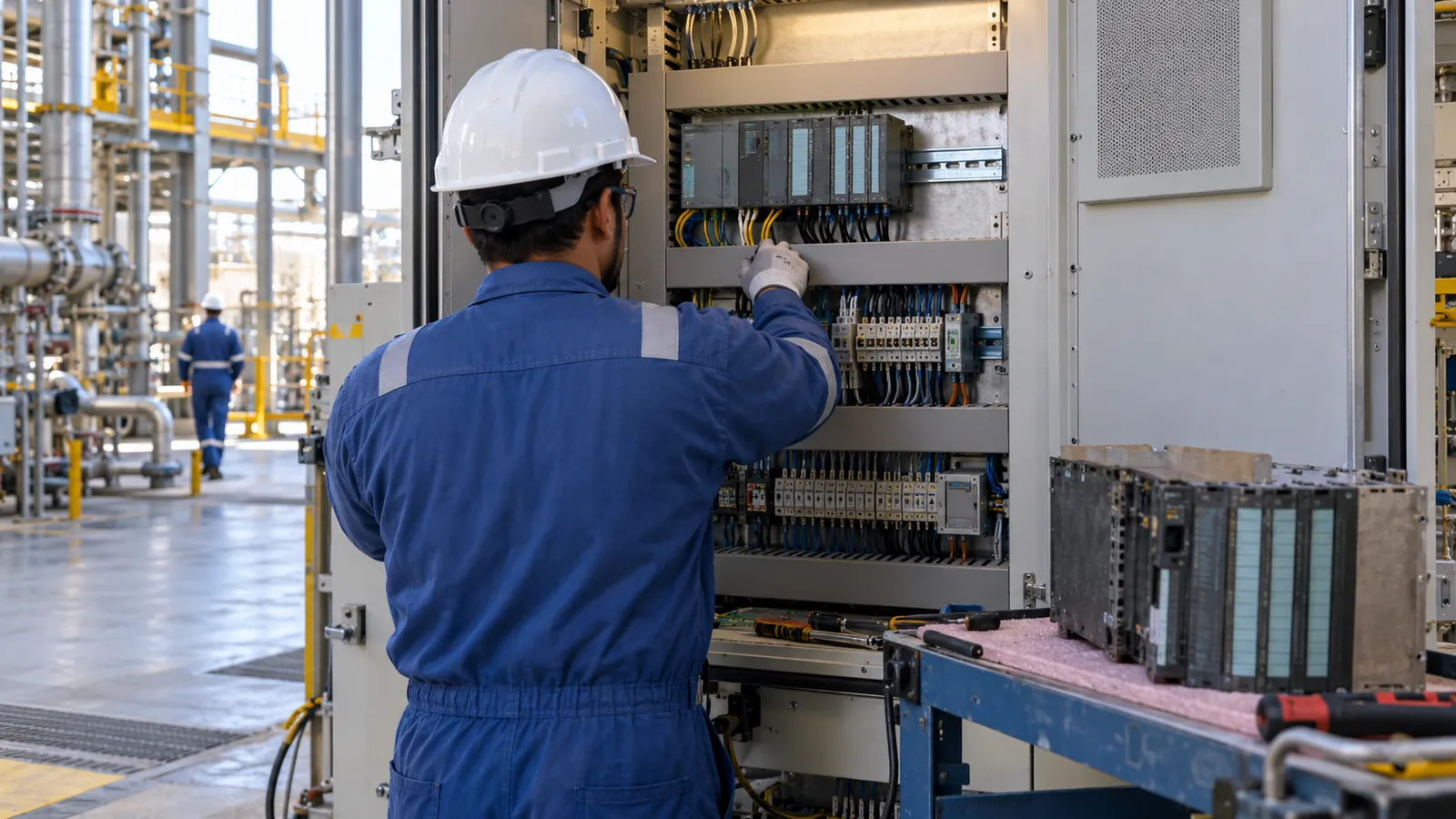
The S7-300 is in Siemens' phase-out lifecycle, and the S7-1500 is its designated successor. That does not stop a running plant, but it changes your risk. Spare CPUs and signal modules become harder to source, repair lead times grow, and the engineers who can read STEP 7 V5.x projects get scarcer each year.
The right moment to migrate is while the plant runs normally, not after a CPU failure stops a unit. We check each module in your racks against Siemens lifecycle data, rank them by criticality and propose a sequence. For the wider decision, read what Saudi plants should do about S7-300 end of life, and use the PLC migration checklist to prepare your cut-over.
S7-300 migration in Saudi Arabia: what we deliver
We migrate the whole control layer, not only the CPU. The table sets out the scope; durations are typical and depend on program size and I/O count.
| Service | Platforms | Standard | Duration |
|---|---|---|---|
| Program conversion | STEP 7 V5.x projects (S7-300/400) converted to TIA Portal for S7-1500; LAD, FBD, STL and SCL reviewed block by block | IEC 61131-3 | 3–8 weeks |
| I/O and hardware mapping | Central and distributed I/O reviewed; modules reused or replaced; address tables and wiring changes issued | To project specification | Within the 3–8 weeks |
| HMI and SCADA | Tag and screen re-linking to the new controller; WinCC (Comfort/Unified) where panels are also replaced | ISA-101 where relevant | 1–4 weeks, in parallel |
| Network | PROFINET design; PROFIBUS retained where field devices stay | IEC 62443 basics for access and segmentation | Within the 3–8 weeks |
| Validation | Offline simulation, functional FAT and a written test record | Per project ITP | Included |
| Cut-over | Executed in planned shutdowns with a rollback plan | Per project schedule | Shutdown window |
| Documentation | Annotated program, I/O list, as-built drawings, backups | Per project | Included |
Our engineers work in Siemens S7-1200/1500 with TIA Portal and in S7-300/400, so the person converting your code also knows how it behaved on the old CPU. Our Siemens TIA Portal programming team handles the new-platform engineering.
What are the key differences between the S7-300 and S7-1500?
The S7-1500 changes how the program is written, addressed and connected, so a migration is more than a hardware swap. The main differences are these.
- Engineering tool. The S7-300 uses STEP 7 V5.x; the S7-1500 uses TIA Portal. Projects are migrated, then reviewed, because absolute addressing, system function calls and some STL constructs need rework.
- Block access. S7-1500 blocks use optimised access by default. Code that reads data blocks by byte offset has to be rewritten or the blocks set to standard access.
- Network. The S7-1500 CPU carries PROFINET. PROFIBUS devices connect through a communication module, and many sites keep them.
- Performance and diagnostics. Scan times fall, and the CPU reports diagnostics your maintenance team can read without extra programming.
- Security. Access protection levels and communication hardening are built in, and we configure them to your site policy.
Where you want to avoid rewiring, existing S7-300 signal modules can often be kept in an ET 200M station connected to the new CPU. We decide module by module during the survey.
How does an S7-300 cut-over work without a long outage?
We prove the new program offline, then change the controller in one planned shutdown with a rollback path ready.
- Enquiry. You send the CPU and module list, the project backup and your shutdown calendar.
- Site data. We back up the live program, record the as-found I/O state and identify what is undocumented.
- Design. We issue the migration plan: reused modules, replacements, network layout and cut-over sequence.
- Programming. We convert and rework the code in TIA Portal and re-link the HMI and SCADA tags.
- FAT. We test the logic against a simulated process and issue the test record before anything is shipped.
- Cut-over. In the shutdown we swap the controller, run loop and interlock checks, and restart under supervision.
- Documentation. You receive the program, I/O list, drawings and backups.
- Support. We stay on call through the first operating weeks. See control system commissioning for how we run this phase.
Who we migrate controllers for
KSA Industrial Automation Company has worked in Saudi Arabia since 1995 and is approved by Saudi Aramco, SABIC and the Royal Commission for Jubail and Yanbu. Our work for all three sits within management systems certified to ISO 9001, ISO 14001 and ISO 45001.
S7-300 racks are common in older refineries, petrochemical units, water plants, cement lines and utilities, which are the sites where uptime matters most. We take projects in all regions of Saudi Arabia, and for sites in the Eastern Province, including Dammam 1st, 2nd and 3rd Industrial Cities, Jubail and Al Khobar, we respond on site within one working day. Where the whole control system is ageing, the broader scope sits under PLC retrofit and upgrade.
Migration questions from plant teams
Who provides S7-300 migration in Saudi Arabia?
KSA Industrial Automation Company provides S7-300 migration from its base in Al Shati, Dammam, with projects delivered in every region of Saudi Arabia. We are approved by Saudi Aramco, SABIC and the Royal Commission, and the engineers who convert your program also commission it on site.
What affects the cost of a migration?
The main factors are program size, the number of I/O points, how much of the existing hardware you reuse, whether the HMI or SCADA also changes, how much documentation is missing and the length of the shutdown. Send the CPU list and a backup, and the proposal prices each factor separately.
How long does a migration take?
Most projects take 3–8 weeks, with the cut-over carried out in a planned shutdown. The schedule depends on program size, I/O count and how quickly you approve the migration plan. Plants with good documentation and a clear shutdown date finish at the short end of that range.
Can we keep our existing I/O modules and wiring?
Often yes. Existing S7-300 signal modules can stay in an ET 200M station behind the new CPU, which keeps the field wiring and shortens the shutdown. We decide this per module in the survey, based on age, condition and availability, and the plan states what is reused and what is replaced.
Do we have to stop the plant for the cut-over?
The controller swap needs a shutdown, but everything before it does not. We convert, simulate and test the program offline, so the plant stops only for the physical change and the final checks. The proposal fixes the sequence and a rollback path so you can plan the stop.
What should I send to get a quotation?
Send the CPU and module list, a backup of the STEP 7 project, any I/O list or drawings you hold, and your next planned shutdown dates. If documentation is missing, photographs of the racks are enough to start. The proposal then sets out scope, duration and price.
Planning an S7-300 migration in Saudi Arabia? Send your CPU list and program backup and receive a quotation within one working day.
Email: inquiry@ksaindustrialautomation.com | Request a quotation