KSA Industrial Automation Company provides pump station automation in Saudi Arabia: PLC control logic, duty and standby sequencing, level and pressure control, telemetry and SCADA for water, wastewater, irrigation and process pumping stations. We programme, test and commission the control system so every station keeps pumping and reports its state to your control room.
What you receive: a written proposal with the control philosophy, I/O scope, telemetry design, test plan and schedule within one working day of receiving your I/O list, P&IDs or functional description. Request a quotation
What does a pump station control system actually do?
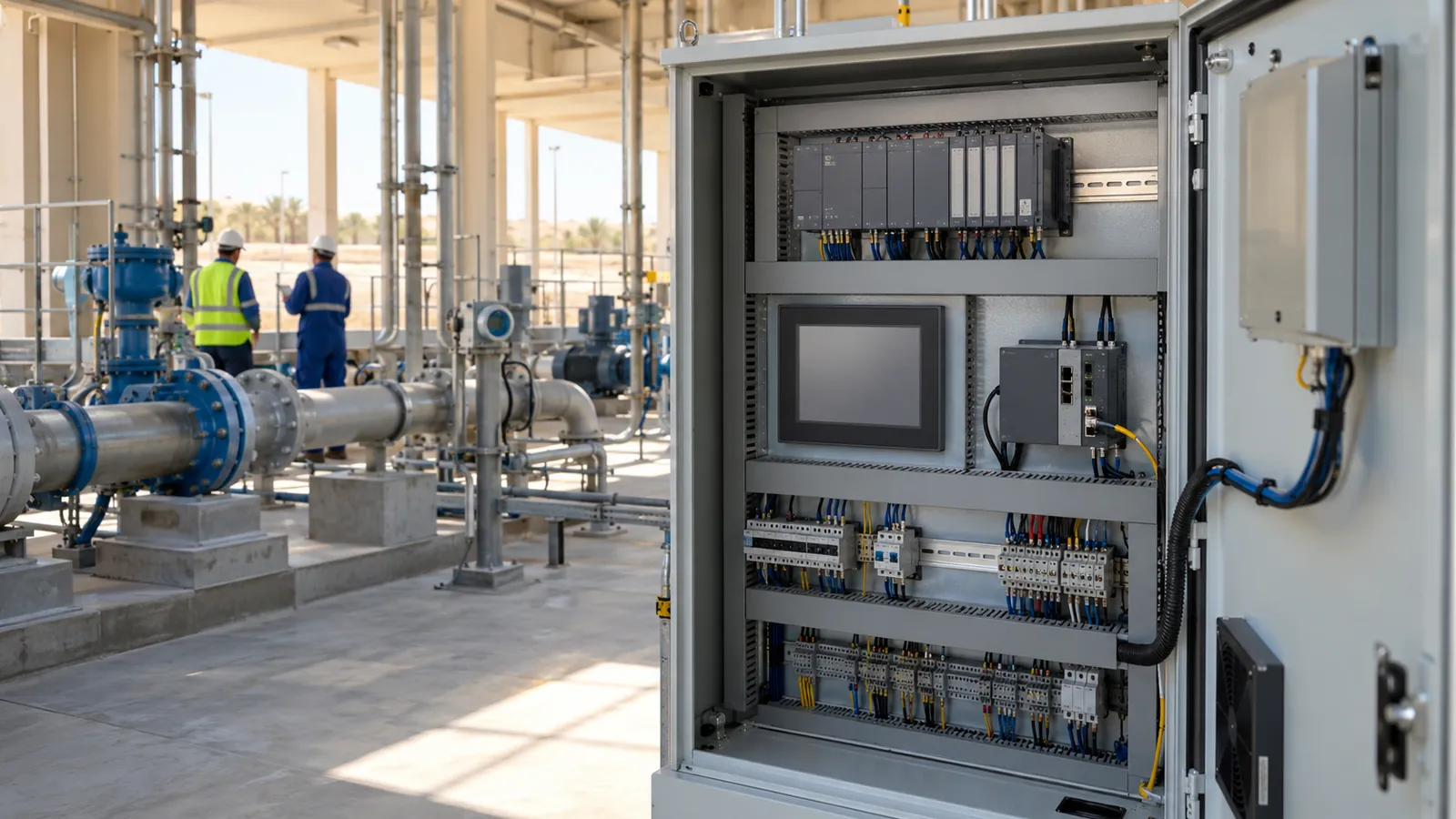
A pump station control system decides which pumps run, when, and what happens when something goes wrong. The PLC reads level, pressure, flow and motor status, then starts and stops pumps to hold the set-point. It also protects the equipment and sends the station state to the control room.
The control logic we write covers:
- duty, assist and standby selection with automatic alternation, so run hours are shared between pumps;
- level-based or pressure-based start and stop bands, with a variable-speed drive loop where the station uses one;
- dry-run, high-temperature, overload and seal-fault trips, each with its own alarm text and reset rule;
- fail-over to a standby pump when a duty pump trips or fails to prove flow;
- Local, Remote and Off selection that cannot be overridden by a command from the wrong place; and
- a defined behaviour when the telemetry link drops, so the station runs on local logic rather than stopping.
Station hardware, meaning the starters, drives and enclosure, is specified by your consultant or supplied by your panel builder. We take the logic, communications and SCADA, and we coordinate the interfaces with whoever builds the cabinet.
Pump station automation in Saudi Arabia: what we deliver
The table sets out the usual scope. Platforms and durations are typical; your proposal fixes them against your I/O count and site conditions.
| Item | Scope / platform | Standard | Typical duration |
|---|---|---|---|
| Station PLC programming | Siemens S7-1200/1500, Rockwell CompactLogix, Schneider Modicon M340/M580 or ABB AC500 | IEC 61131-3 | 2–6 weeks per system |
| Local HMI | Pump status, set-points, alarms and trends at the station | ISA-101 where specified | 1–4 weeks |
| Telemetry and RTU communication | Modbus, DNP3, OPC UA or MQTT over 4G, fibre or radio | Client protocol standard | 3–8 weeks |
| Central SCADA | WinCC, FactoryTalk, AVEVA or Ignition; multi-station overview, alarms, reports | ISA-18.2 alarm practice | 4–12 weeks |
| FAT, SAT and loop checks | Simulated-station test, then live loop checks and performance run | Client ITP | Per project schedule |
We programme on Siemens, Rockwell, Schneider and ABB platforms and build with ABB, Schneider Electric and Siemens components.
How does telemetry connect a pump station to SCADA?
Telemetry connects a station to SCADA by carrying its data over a communication link to the central server. A PLC or RTU at the station polls its instruments, stores the readings and sends them on a schedule or on change. The link is usually 4G, fibre or licensed radio, chosen by the coverage at each site.
Remote stations fail in predictable ways, so we design for them. Readings are time-stamped at the station and buffered during an outage, which means the trend has no gap once the link returns. Alarms carry priorities, so an operator sees a failed duty pump before a low battery. Where several stations share one network, we poll in sequence and size the scan time to your slowest link. The RTU and telemetry page covers the field devices in more detail, and our article on pump station automation benefits explains the energy and call-out effect.
How is a pump station project delivered?
- Enquiry. You send the I/O list, P&IDs or a functional description of the station.
- Site data. We confirm the pump arrangement, instruments, communication coverage and the existing SCADA, if any.
- Design. We issue the control philosophy, cause-and-effect matrix and communication architecture for your approval.
- Programming. We write the PLC and HMI to the approved philosophy and build the SCADA faceplates.
- Factory acceptance test. We test the logic against simulated pumps and instruments, including every trip and fail-over case, with your witness if you wish.
- Site acceptance and commissioning. We carry out loop checks, run each pump on site and prove the telemetry end to end. See control system commissioning.
- Documentation. You receive the as-built logic, source code backups, alarm list and operating notes.
- Support. We remain available for changes, new stations and fault call-outs.
Who we automate pump stations for
KSA Industrial Automation Company has worked in Saudi Arabia since 1995 and is approved by Saudi Aramco, SABIC and the Royal Commission for Jubail and Yanbu. We have carried out projects for all three, under systems certified to ISO 9001, ISO 14001 and ISO 45001.
Pumping stations sit in water transmission and distribution networks, wastewater collection, irrigation, industrial cooling water, firewater and process transfer duties. They are often unmanned and far from the workshop, which is why logic that survives a lost link and a clear alarm list matter more than screen design. Our engineering base is Al Shati District in Dammam, and we take projects in all regions of Saudi Arabia. For utility-scale networks, see our work for water and wastewater operators.
Common questions before you request a quotation
Who provides pump station automation in Saudi Arabia?
KSA Industrial Automation Company provides PLC logic, telemetry and SCADA for pumping stations across Saudi Arabia. We have worked on projects for Saudi Aramco, SABIC and the Royal Commission, and we are based in Dammam. We commission the station on site and support it afterwards.
What affects the cost of automating a pump station?
The main factors are the number of pumps and instruments, the PLC platform, how many stations share one SCADA, the communication medium at each site, the alarm and reporting requirements, and the test regime. Your I/O list and a short functional description let us price each of these against your specification.
How long does it take to automate a pump station?
For one station, programming typically takes a few weeks, followed by factory and site testing. Several stations feeding one SCADA take longer because of the telemetry work. Approval turnaround on the control philosophy and access to site for loop checks affect the schedule more than programming time does.
Can you upgrade the controls of a pump station that is already running?
Yes. We read the existing logic, document how the station behaves, then prepare a cut-over plan that keeps the station supplying throughout. New logic is tested offline first, and the change-over is scheduled for a low-demand window with the old controller available as a fallback until the new one has proved itself.
What happens when communication to the station is lost?
The station keeps running on its local logic: it holds its mode, keeps the level or pressure band, and logs events with time stamps. When the link returns, buffered data reaches SCADA and the gap closes. You can also set the station to a defined safe state if a link is lost for longer than an agreed period.
What should I send to get a quotation?
Send the pump and instrument schedule, P&IDs or a functional description, and tell us the SCADA platform you use. A photo of the existing control cabinet helps on upgrades. Your proposal then sets out scope, standards, duration and price.
Pump station automation in Saudi Arabia starts with your I/O list. Share your I/O list, P&IDs or a functional description and your quotation arrives within one working day. Email: inquiry@ksaindustrialautomation.com | Request a quotation