
KSA Industrial Automation Company designs and commissions a remote monitoring system for industrial plants, pump stations, tank farms and unmanned sites across Saudi Arabia. Field signals reach your control room over 4G, fibre or radio, with alarms, trends and reports on any approved device. A typical telemetry and IIoT system takes 3 to 8 weeks.
What you receive: a written proposal with the signal list, communication route, platform, schedule and price within one working day of receiving your I/O list, P&IDs or functional description. Request a quotation
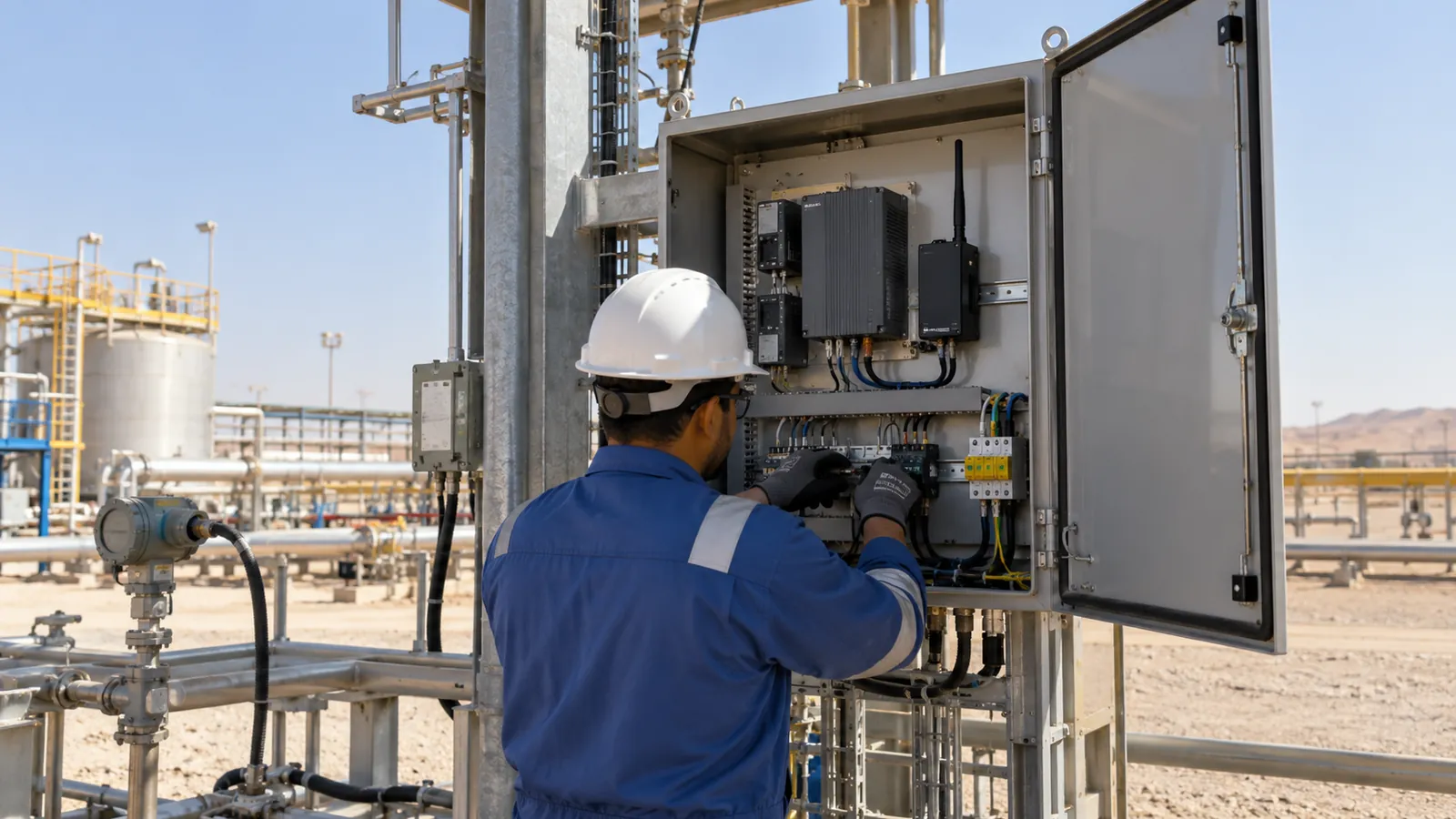
What is a remote monitoring system?
A remote monitoring system collects readings and status signals from equipment at a distant site, sends them over a communication link and presents them to operators in one central place. It lets a small team watch many sites without driving to each one.
Every system we build has the same five layers:
- Field instruments: level, flow, pressure, temperature and analyser transmitters, plus run, fault and position signals.
- Outstation: an RTU or PLC that reads the signals, applies local logic and keeps a buffer of data.
- Communications: a 4G router, fibre link or licensed radio, depending on the site.
- Server or platform: a SCADA server, an Ignition gateway or a cloud service that stores history.
- Operator screens and alarms: dashboards, trends, reports and notification by SMS or email.
Monitoring can stay read-only, or you can add remote control later without replacing the hardware. Our RTU and telemetry service covers the outstations, and SCADA integration covers the central platform.
Remote monitoring system for industrial sites: what we deliver
Each scope is built around your signal list. The table sets out the main items.
| Item | Range / platforms | Protocols and standards | Typical duration |
|---|---|---|---|
| RTU and telemetry outstation | Siemens S7-1200/1500, Rockwell CompactLogix, Schneider Modicon M340/M580, ABB AC500 | Modbus, Profinet, Ethernet/IP, DNP3; logic to IEC 61131-3 | 3–8 weeks |
| IIoT gateway and data link | 4G, fibre and radio | OPC UA, MQTT, DNP3, Modbus | 3–8 weeks |
| Dashboards and reports | WinCC, FactoryTalk, AVEVA (Wonderware), Ignition | ISA-101 screen practice where relevant | SCADA 4–12 weeks; HMI 1–4 weeks |
| Alarm management | Priorities, set points, escalation and shelving rules | ISA-18.2 where relevant | Included with the dashboards |
| Network security basics | Segmented networks, VPN access, user roles | IEC 62443 basics | Included with the system |
| Site acceptance | End-to-end signal test from the field device to the screen | Test record per signal | Per project schedule |
How does a remote monitoring system connect over 4G, fibre and radio?
Choose the link from the site, not from habit. A 4G router with a private APN or VPN suits sites inside cellular coverage and keeps cost low. Fibre suits sites inside a plant or industrial city where cable already exists. Licensed radio suits long pipelines and remote stations where no mobile signal reaches.
Our telemetry designs use Modbus, DNP3, OPC UA and MQTT over 4G, fibre or radio. Whatever the link, we design for the day it drops. The outstation buffers readings with time stamps and sends them when the link returns, so your trends show no gaps. Report-by-exception keeps data use low on cellular links, while a slow background poll confirms that the site is alive.
What can you monitor remotely and who gets the alarm?
Anything that produces a signal can be monitored. Typical points on our projects include:
- pump run, fault, discharge pressure and wet-well level;
- tank level, high-high alarms and transfer status;
- flow totals and meter readings for reporting;
- compressor, blower and skid status;
- analyser values such as pH, chlorine, turbidity and conductivity; and
- incoming supply, UPS and door status at unmanned sites.
Alarms are the reason most clients ask for a remote monitoring system, so we set them up with care. We agree priorities and set points with your operations team, route each alarm to the right person by SMS, email or dashboard, and add acknowledgement and escalation so nothing waits on one phone. Nuisance alarms are removed in the design, not left for operators to ignore.
How is a remote monitoring system built and commissioned?
- Enquiry. You send the I/O list, P&IDs or a functional description of the sites.
- Site data. We confirm instruments, power, cellular coverage or radio path, and where the outstation will mount.
- Design. We issue the signal list, network drawing, platform choice and alarm schedule for your approval.
- Programming. We write the outstation logic, gateway configuration, screens and reports.
- Factory acceptance test. We test the logic and communications on a bench with simulated signals and record the result.
- Installation support. We guide your installers on mounting, earthing, surge protection and antenna positions.
- Site acceptance. We test every signal from the field device to the operator screen, then train your team.
- Documentation and support. You receive drawings, the signal list, configuration backups and a support route.
Read how we run the on-site stages in control system commissioning.
Who we build monitoring systems for
KSA Industrial Automation Company has worked in Saudi Arabia since 1995, is approved by Saudi Aramco, SABIC and the Royal Commission for Jubail and Yanbu, and has worked on projects for all three. The company's management systems are certified to ISO 9001, ISO 14001 and ISO 45001. We deliver projects in all regions of Saudi Arabia.
Remote monitoring pays back fastest where sites are many, spread out and rarely staffed: water pumping stations, effluent and treatment plants, tank farms, compressor skids and utility yards in the Eastern Province, Jubail, Yanbu and beyond. See how this applies to pump station automation and tank farm monitoring. Emergency support is remote on the same day, and on site within one working day in the Eastern Province.
Remote monitoring questions
Who provides a remote monitoring system for industrial plants in Saudi Arabia?
KSA Industrial Automation Company provides a remote monitoring system for industrial plants from its Dammam base, covering design, programming, commissioning and support. We work with Siemens, Rockwell, Schneider and ABB platforms and have delivered projects in every region of Saudi Arabia.
What affects the cost of a remote monitoring system?
Cost follows the number of sites, the signals per site, the communication link, the platform licences, the alarm and report requirements and the security level. Distance and site access also matter. A signal list with site locations lets us price each of these separately in the proposal.
How long does a remote monitoring system take to deliver?
Most telemetry and IIoT systems take 3 to 8 weeks, and larger SCADA platforms take 4 to 12 weeks. The schedule depends on the number of sites, how quickly drawings are approved, equipment delivery and the access dates you can give us for installation and testing.
Is remote access to my plant secure?
We design remote access with segmented networks, VPN or private APN connections, named user accounts with roles, and no open inbound ports on the plant network. We apply the basics of IEC 62443 and agree the access rules with your IT team before anything goes live.
Can you add remote monitoring to existing PLCs and older equipment?
Yes. Most existing PLCs, drives, meters and analysers can be read over Modbus, Profinet, Ethernet/IP or OPC UA, and an IIoT gateway then carries the data out. Where a device has no digital port, we read its hardwired outputs through a small RTU instead.
What should I send to get a quotation?
Send your I/O list, P&IDs or a functional description of what must be monitored. Add site locations, the existing PLC or SCADA make, and any alarm requirements you already have. The proposal then sets out the scope, platform, schedule and price.
Need a remote monitoring system for industrial sites in Saudi Arabia? Send us your site list and signal schedule and receive a quotation within one working day.
Email: inquiry@ksaindustrialautomation.com | Request a quotation