
Remote monitoring for unmanned sites works by putting a small controller or RTU at the site, linking it to a central system over 4G, fibre or radio, and routing alarms to people who can act. Design around three questions: what must you know, how fast, and what happens when the link or the power fails.
What you receive: send your site list, signals per site and available communications and we return a written design and proposal within one working day. Request a quotation
By Eng. Junaid Ali, KSA Industrial Automation Company. Published October 2026.
What is a remote monitoring system?
A remote monitoring system collects readings and states from equipment at distant sites and presents them in one place. The site device reads sensors, runs basic logic and sends data. The central system stores it, draws trends and raises alarms. Control commands can travel the other way when the design allows them. Many owners start with monitoring only and add remote control later, once the link has proved reliable and the safety rules for remote operation are agreed.
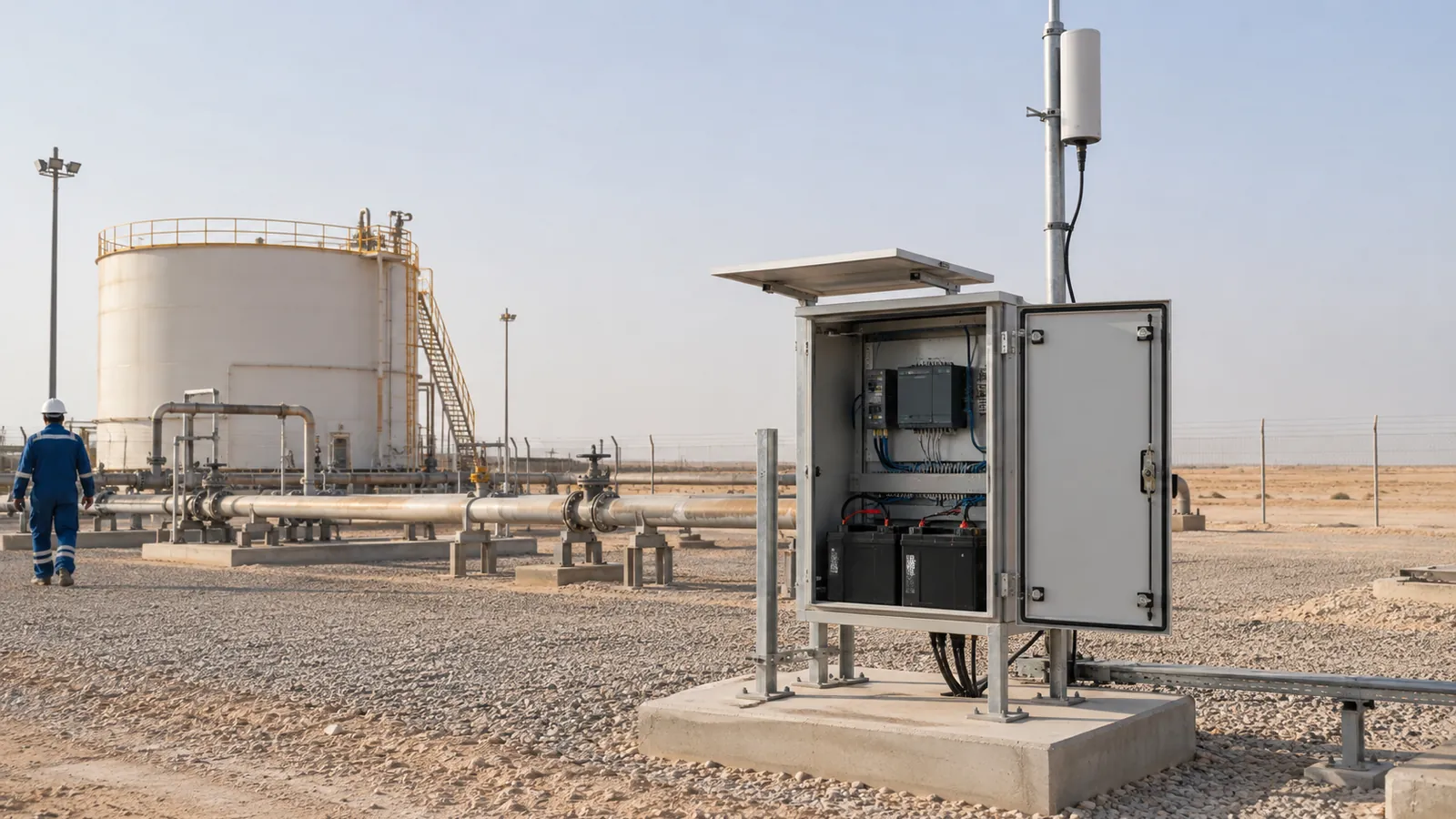
For unmanned sites such as tank farms, pump stations, wellheads, boosters or telecom shelters, the system replaces routine visits and gives early warning of faults.
What does remote monitoring for unmanned sites need at each level?
The table lists the layers and typical choices.
| Layer | Purpose | Typical options |
|---|---|---|
| Field devices | Measure levels, flows, pressures, run states, alarms | 4–20 mA transmitters, switches, meters |
| Site controller or RTU | Read signals, run local logic, buffer data | PLC or RTU with Modbus, DNP3, Profinet, EtherNet/IP |
| Communications | Carry data to the centre | 4G, fibre, licensed or unlicensed radio |
| Protocol | Format the data | DNP3, Modbus, OPC UA, MQTT |
| Central system | Store, display, alarm, report | SCADA, historian, cloud dashboard |
| People | Act on alarms | Operators, on-call engineers, contractors |
Which communication link suits an unmanned site?
Pick the link by coverage, data volume, latency and cost over the site life. Run a signal survey at the actual cabinet position before ordering, because coverage maps differ from what an antenna sees behind a tank or a wall, and a short external antenna mast is often the cheapest fix.
- 4G cellular: quick to deploy where coverage is good; use an industrial router with a private APN or VPN where the carrier offers it.
- Fibre: high capacity and stable, but only where a route exists.
- Radio: private licensed or unlicensed links suit clusters of sites or areas without coverage, at the price of a survey and masts.
- Dual path: 4G with a radio or second carrier for critical sites, switching automatically on failure.
Whatever you choose, protect the data path. IEC 62443 gives the framework for secure design; basic steps are VPN tunnels, no open inbound ports and unique credentials per site.
Worked example: a data budget for a remote tank site
This is an example to show the method; your site will differ. A tank site sends 20 tags each minute using MQTT. Assume each message, including overhead, averages 40 bytes.
| Step | Calculation | Result |
|---|---|---|
| Messages per day | 20 tags × 1,440 minutes | 28,800 |
| Bytes per day | 28,800 × 40 | 1,152,000 (about 1.15 MB) |
| Bytes per 30-day month | 1,152,000 × 30 | about 34.6 MB |
| With report by exception at 10% of samples | 34.6 MB × 0.10 | about 3.5 MB |
Reporting by exception means the RTU sends a value only when it changes by more than a set deadband, and sends a periodic heartbeat so the centre knows the site is alive. The SIM data plan can be small, but the real gain is clearer trends and fewer false alarms. Tags are still logged at one-minute rate on site and forwarded when the link returns, a feature known as store-and-forward.
How should alarms and failures be handled?
Decide the response before you install anything.
- Define which alarms need a call-out and which only need a log entry.
- Route critical alarms to a named on-call person, with escalation to a second after a set time.
- Monitor the link itself: a missed heartbeat is an alarm.
- Add battery or UPS backup so the site reports its own power failure.
- Test every alarm path during commissioning, including the escalation.
An unmanned site that goes silent is the worst failure, because nobody knows. Heartbeat monitoring prevents that. Choose alarm text that tells the on-call person what to do, such as "Tank 2 level high-high, inlet valve closed", instead of a bare tag name. Review the alarm log monthly and remove alarms that produced calls with no action, so the on-call team keeps trusting the messages.
KSA Industrial Automation Company integrates Modbus, Profinet, Ethernet/IP, DNP3, OPC UA and MQTT over 4G, fibre and radio, with typical projects taking 3–8 weeks, for clients including Saudi Aramco, SABIC and the Royal Commission for Jubail and Yanbu. The remote monitoring and IIoT page lists our scope, RTU and telemetry covers the site device, and SCADA integration covers the central system.
Common questions about remote monitoring for unmanned sites
What can be monitored at an unmanned site?
Almost any signal: tank levels, flows, pressures, motor states, power status, door contacts, temperatures and alarms from other equipment. List the signals that change a decision and start with those, then add more once the link is proven.
Can remote monitoring work without internet?
Yes. Radio and private fibre links carry data to your own SCADA without the public internet. Cellular links use the carrier network but can be isolated with a private APN or VPN, so the system does not depend on open internet access.
What happens when the communication link fails?
The site controller keeps running its local logic and stores readings. When the link returns, it forwards the buffered data, so the history has no gap. The centre raises a communication alarm at the first missed heartbeat.
How much does remote monitoring cost?
Cost depends on the number of sites and signals, the controller or RTU, the communication method and its running charges, power backup, dashboards and licences, and installation access. A proposal from your site list shows capital and running cost separately.
How long does installation take?
RTU, telemetry and IIoT projects typically take 3–8 weeks. Site count, survey results, communication approvals and the testing of every alarm path decide where in the range your project falls.
Planning remote monitoring for unmanned sites? Send your site list, signals per site and communication options and receive a quotation within one working day. Email: inquiry@ksaindustrialautomation.com | Request a quotation